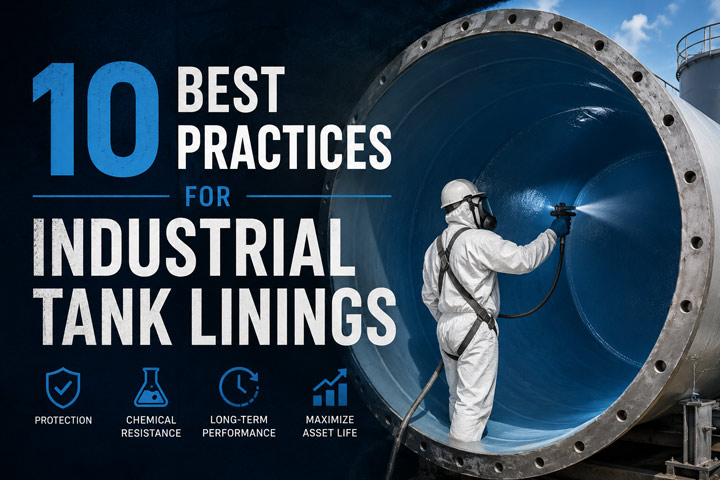
Industrial tank linings play a critical role in protecting storage tanks from corrosion, chemical attack, abrasion, and contamination. Whether used in chemical processing, wastewater treatment, food production, or petroleum storage, the right lining system can dramatically extend asset life and reduce maintenance costs. However, even the highest-performing coating system can fail prematurely if proper procedures are not followed.
Here are the 10 best practices every facility manager, engineer, and maintenance team should follow to maximize the performance and longevity of industrial tank linings.
1. Choose the Right Lining for the Chemical Environment
Not all tank linings are created equal. Selecting the proper coating system begins with understanding the tank’s operating conditions, including:
- Chemical exposure
- Temperature ranges
- Immersion conditions
- Abrasion levels
- Pressure fluctuations
For example:
- Epoxy novolac linings offer exceptional chemical resistance
- Polyurea systems provide rapid cure and flexibility
- Vinyl ester linings excel in highly aggressive chemical environments
- Polyurethane coatings provide UV and abrasion resistance
Improper lining selection is one of the leading causes of premature coating failure.
2. Prioritize Surface Preparation
Surface preparation is arguably the most important step in any tank lining project. Industry experts consistently identify poor surface prep as the primary cause of coating failure.
Best practices include:
- Abrasive blasting to SSPC-SP10 / NACE No. 2 standards
- Removing rust, mill scale, oils, salts, and contaminants
- Creating the correct anchor profile for adhesion
- Performing soluble salt testing before application
A properly prepared substrate ensures strong mechanical bonding and long-term durability.
3. Verify Environmental Conditions During Application
Temperature, humidity, and dew point directly impact coating performance.
Before and during application:
- Monitor the steel surface temperature
- Control humidity levels
- Ensure substrate temperature remains above dew point
- Use dehumidification when necessary
Applying coatings outside the manufacturer's specifications can lead to blistering, poor adhesion, and a shortened service life.
4. Follow Manufacturer-Specified Film Thickness
Every tank lining system is engineered to perform within a specified dry film thickness (DFT).
Too thin:
- Reduced chemical resistance
- Increased permeation risk
- Pinholes and holidays
Too thick:
- Improper curing
- Cracking or delamination
- Solvent entrapment
Use wet film gauges during application and verify final DFT with calibrated inspection equipment.
5. Use Qualified and Certified Applicators
Tank lining installation is highly specialized work that requires trained professionals.
Experienced applicators understand:
- Surface profile requirements
- Multi-coat application timing
- Ventilation needs
- Confined space safety
- Cure schedules
- Inspection standards
Facilities should work with contractors certified by organizations such as AMPP (formerly NACE) whenever possible.
6. Allow Proper Cure Time Before Service
One of the most common mistakes in industrial coating projects is rushing the return-to-service schedule.
Many coatings require:
- Initial handling cure
- Service cure
- Full chemical cure
Premature exposure to chemicals or immersion conditions can permanently damage a newly installed lining system. Cure time varies depending on:
- Coating chemistry
- Temperature
- Humidity
- Film thickness
Proper curing directly impacts chemical resistance and long-term performance.
7. Perform Holiday and Adhesion Testing
Inspection and quality control should never be skipped.
Critical tests include:
- Holiday testing for pinholes and voids
- Adhesion testing
- Visual inspections
- Dry film thickness verification
- Surface profile measurements
Holiday detection is especially important in immersion-service tanks where even microscopic defects can lead to corrosion under the lining.
8. Ensure Chemical Compatibility Testing
Chemical resistance claims should always be backed by testing data.
Standards such as:
- ASTM C868
- ASTM C581
- ISO 2812
help evaluate long-term immersion performance and resistance to aggressive chemicals. These tests simulate real-world exposure conditions to identify risks like blistering, permeation, and delamination before installation.
9. Implement Routine Inspection and Maintenance Programs
Even high-performance tank linings require periodic inspection.
A proactive maintenance program should include:
- Scheduled visual inspections
- Thickness checks
- Corrosion monitoring
- Repair of localized damage
- Documentation of service conditions
Early detection of coating issues can prevent costly tank failures and extend inspection intervals in accordance with standards such as API 653.
10. Work With a Specialized Tank Lining Partner
Industrial tank lining systems are long-term infrastructure investments. Partnering with a knowledgeable contractor ensures proper specification, installation, inspection, and maintenance throughout the asset lifecycle.
An experienced lining specialist can help:
- Identify the optimal coating system
- Ensure regulatory compliance
- Reduce downtime
- Improve safety
- Extend tank service life
The right partner helps protect both your assets and your operation.
Final Thoughts
Industrial tank linings are essential for protecting valuable infrastructure against corrosion, contamination, and chemical attack. By following proven best practices — from proper surface preparation to routine inspections — facilities can dramatically improve coating performance and reduce long-term maintenance costs.
Successful tank lining projects are built on careful planning, quality materials, skilled application, and ongoing maintenance. When executed properly, a high-performance lining system can provide decades of reliable service in even the harshest industrial environments.
For facilities looking to maximize asset protection and operational reliability, investing in the right tank lining strategy is one of the smartest long-term decisions you can make.
At UCC, we understand that industrial tank linings are more than protective coatings — they are a critical investment in the longevity, safety, and performance of your operation. Our team specializes in high-performance corrosion protection systems engineered for demanding industrial environments, including chemical processing, wastewater treatment, manufacturing, and storage.
From surface preparation and material selection to expert application and quality inspection, UCC delivers turnkey tank lining solutions that maximize asset life, minimize downtime, and ensure long-term reliability. With decades of experience and a commitment to quality workmanship, UCC is the trusted partner industries rely on for durable, high-performance tank lining systems.